In our years of research of Nathan it is our
logical deduction that he was from Rutherford County, North Carolina,
although no absolute proof has been found to verify this claim.
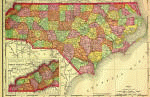 Rutherford County came into existence in 1779
during the American Revolution. Prior to 1779, Rutherford County was
formerly part of Tryon County, North Carolina. In 1771 Governor Tryon
called out 5 militiamen of Tryon County to help put down the Regulator
movement, a protest against corrupt county officials and excessive taxes,
centered in counties to the northeast of Tryon. Although the colony was
officially at peace with the Indians from 1763 to 1776, the Tryon County
frontier was the target of occasional raids, usually by Cherokees but
sometimes by Shawnees and other faraway tribes. The county sent two
representatives to the First Provincial Congress in 1774. On August 14,
1775 the Committee drafted an "Association" to be signed by the people of
the county. These resolutions deplored the fighting that had already begun
in Massachusetts and declared that the time had come "to take up arms and
risk our lives and fortunes, in maintaining the freedom of our country".
Cherokee war parties, encouraged by British agents, attacked several Tryon
County settlements in July 1776. Neighbor joined neighbor, Tories joined
Whig in fighting off the raiders and marching with General Griffith
Rutherford to devastate the Cherokee towns across the Blue Ridge. Crippled
by this destruction, the Cherokees never again posed a major threat to the
country, but small raids continued, and the militia had to patrol the
frontier and man the forts almost constantly.
Rutherford County came into existence in 1779
during the American Revolution. Prior to 1779, Rutherford County was
formerly part of Tryon County, North Carolina. In 1771 Governor Tryon
called out 5 militiamen of Tryon County to help put down the Regulator
movement, a protest against corrupt county officials and excessive taxes,
centered in counties to the northeast of Tryon. Although the colony was
officially at peace with the Indians from 1763 to 1776, the Tryon County
frontier was the target of occasional raids, usually by Cherokees but
sometimes by Shawnees and other faraway tribes. The county sent two
representatives to the First Provincial Congress in 1774. On August 14,
1775 the Committee drafted an "Association" to be signed by the people of
the county. These resolutions deplored the fighting that had already begun
in Massachusetts and declared that the time had come "to take up arms and
risk our lives and fortunes, in maintaining the freedom of our country".
Cherokee war parties, encouraged by British agents, attacked several Tryon
County settlements in July 1776. Neighbor joined neighbor, Tories joined
Whig in fighting off the raiders and marching with General Griffith
Rutherford to devastate the Cherokee towns across the Blue Ridge. Crippled
by this destruction, the Cherokees never again posed a major threat to the
country, but small raids continued, and the militia had to patrol the
frontier and man the forts almost constantly.
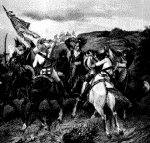 A story passed down through generations of our
family states that as a boy Nathan lived on a farm that his father owned
or managed on or near where the "Battle of Cowpens" was fought in 1781.
The following paragraph lays claim to his birth being in Rutherford
County, North Carolina:
A story passed down through generations of our
family states that as a boy Nathan lived on a farm that his father owned
or managed on or near where the "Battle of Cowpens" was fought in 1781.
The following paragraph lays claim to his birth being in Rutherford
County, North Carolina:
The term "cowpen" was associated in colonial
times with an open-range stock raising operation bearing many similarities
to the Western cattle ranch of today. The cowpen was an institution that
originated in the low country of South Carolina, and which was less common
in the piedmont than in parts of the state (SC) much further south. The
cowpens from which the battle site takes its name is sometimes referred to
as "Hannah's Cowpens or as Saunders's Cowpens. This "cowpens" site was a
place of considerable notoriety fro a trading path with the Cherokees
which passed by it. Modern researchers have been unable to locate records
connecting the site to its original owner, although it was customary for "cowpen"
owners to hold title to the ground on which their buildings and cattle
enclosures were erected. An 1803 state grant to Daniel McClary is the
earliest record of the site. If you review the site and the closest Kemp
or Camp family living near there a Thomas Camp settled in Island Ford,
Rutherford County, North Carolina, which is about two miles north of the
South Carolina state line or just over two miles from the site of the
"Battle of Cowpens". However, no proof has been located that can link
Thomas Camp to Nathan L. Kemp.
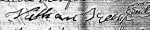 In an affidavit sworn in McNairy County,
Tennessee Court in 1857. Nathan states that in 1793 he enlisted to fight
the Cherokee Indians and mustered out of Oconee Station, South Carolina.
By, 1797 he can be found in Franklin County, Georgia where he is listed on
tax lists from 1800 to 1809. All children from Nathan's first marriage to
Nancy Walters/Waters state in future census records that their birth place
was the state of Georgia.
In an affidavit sworn in McNairy County,
Tennessee Court in 1857. Nathan states that in 1793 he enlisted to fight
the Cherokee Indians and mustered out of Oconee Station, South Carolina.
By, 1797 he can be found in Franklin County, Georgia where he is listed on
tax lists from 1800 to 1809. All children from Nathan's first marriage to
Nancy Walters/Waters state in future census records that their birth place
was the state of Georgia.
A list of taxable property in Madison County,
Mississippi Territory dated July 19, 1810 places Nathan as either owning
land or living in Madison County, Mississippi Territory in 1810. This
later became Madison County, Alabama. Madison County was created by
Mississippi Territory Governor Robert Williams on December 13, 1808.
Additional land was added until the county achieved its current form in
1824. The first white settlers entered the area in 1804. The area was
previously inhabited by Cherokee and Chickasaw Indians. The county seat
was established at Huntsville.
The first white settlers entered the area in 1804. The area was
previously inhabited by Cherokee and Chickasaw Indians. The county seat
was established at Huntsville.
In the same affidavit mentioned above, Nathan
states that in April of 1813, he enlisted in the Creek War from Madison
County for six months. On November 4, 1813 Nathan married Margary
Brashears in Madison County. The license/bond spells his name as Nathan
Camp. This is the one and only document which spells his name in that
manner. All children born to Nathan and Margary give their birth places as
the state of Alabama, except for their youngest son, James.
 Sometime between 1828 and 1829, Nathan moved his
second wife Margary and their children to McNairy County, Tennessee.
Nathan's older sons and daughters from his first marriage also followed
their father into McNairy County, all by the year 1830. The 1830 census of
McNairy County listed Nathan, as well as, his older sons. Nathan can be
found on the 1830, 1840 and 1850 census of McNairy County, Tennessee. In
early fall of 1857 Nathan's youngest son, James decided to move himself
and his wife to Hot Spring County, Arkansas. James was living at that time
at home with his father and mother and his new wife, Matilda. For whatever
reason, at the age of 83, Nathan decided to make the move to Arkansas. The
following is a story of that move:
Sometime between 1828 and 1829, Nathan moved his
second wife Margary and their children to McNairy County, Tennessee.
Nathan's older sons and daughters from his first marriage also followed
their father into McNairy County, all by the year 1830. The 1830 census of
McNairy County listed Nathan, as well as, his older sons. Nathan can be
found on the 1830, 1840 and 1850 census of McNairy County, Tennessee. In
early fall of 1857 Nathan's youngest son, James decided to move himself
and his wife to Hot Spring County, Arkansas. James was living at that time
at home with his father and mother and his new wife, Matilda. For whatever
reason, at the age of 83, Nathan decided to make the move to Arkansas. The
following is a story of that move:


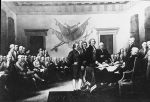 The first Continental Congress met in
Philadelphia, from September 5th to October 26th, 1774. The Congress sat
in Carpenters Hall. They affirmed the right of the colonies to life,
liberty and property. Fifty-six delegates attended, half of whom were
lawyers. The British were shocked by the destruction of the tea in Boston
Harbor and other colonial protests which occurred in early 1774. The
British parliament gave its speedy assent to a series of acts that became
known as the "Coercive Acts"; or in the colonies as the "Intolerable
Acts". These acts included the closing of the port of Boston, until such
time as the East India tea company received compensation for the tea
dumped into the harbor. The Royal governor took control over the
Massachusetts's government and would appoint all officials. Sheriffs would
become royal appointees, as would juries. In addition, the British took
the right to quarter soldiers anywhere in the colonies. Such was the
beginning of a new country, at the time of the birth of our Nathan L. Kemp
on February 3, 1774. Family lore and some old written correspondence
between family members from the last century and the beginning of this
century give his birth place as Rutherford or Rockingham County, North
Carolina.
The first Continental Congress met in
Philadelphia, from September 5th to October 26th, 1774. The Congress sat
in Carpenters Hall. They affirmed the right of the colonies to life,
liberty and property. Fifty-six delegates attended, half of whom were
lawyers. The British were shocked by the destruction of the tea in Boston
Harbor and other colonial protests which occurred in early 1774. The
British parliament gave its speedy assent to a series of acts that became
known as the "Coercive Acts"; or in the colonies as the "Intolerable
Acts". These acts included the closing of the port of Boston, until such
time as the East India tea company received compensation for the tea
dumped into the harbor. The Royal governor took control over the
Massachusetts's government and would appoint all officials. Sheriffs would
become royal appointees, as would juries. In addition, the British took
the right to quarter soldiers anywhere in the colonies. Such was the
beginning of a new country, at the time of the birth of our Nathan L. Kemp
on February 3, 1774. Family lore and some old written correspondence
between family members from the last century and the beginning of this
century give his birth place as Rutherford or Rockingham County, North
Carolina.